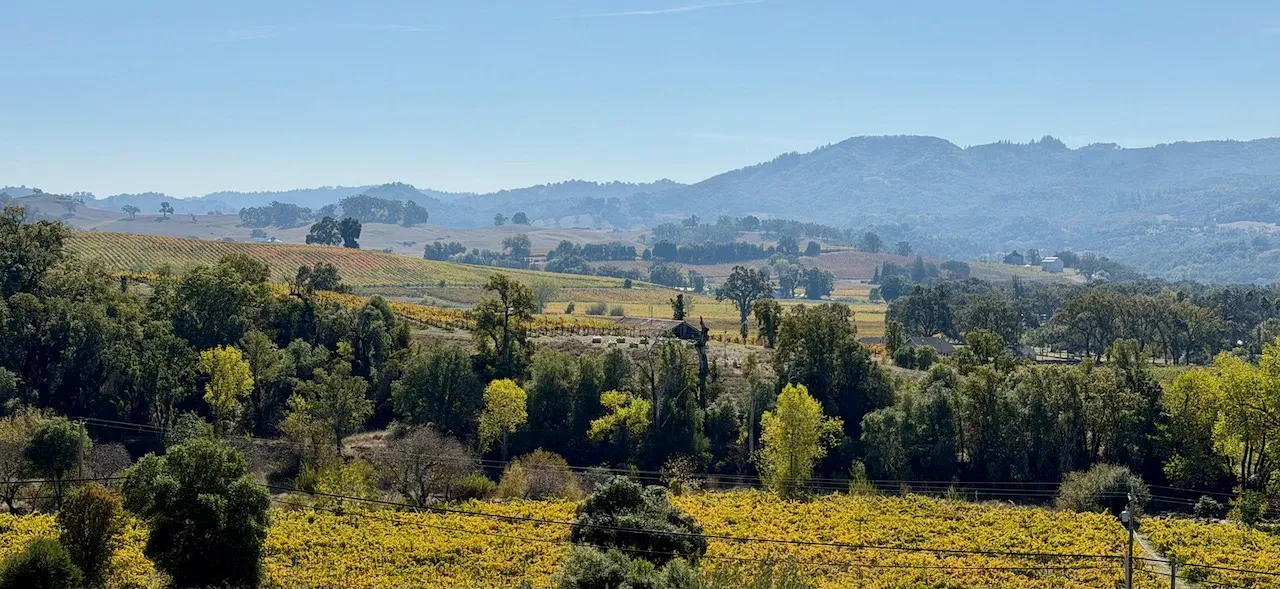
Arinesa Estate is a tiny slice of heaven, about ninety minutes' easy drive from San Francisco. It sits in the bucolic hamlet of Hopland — a little over eight acres on a hill facing a beautiful peak the locals call Duncan Peak. A large estate winery borders it to the east and a boutique winery to the south, with endless vistas of nearby vineyards, mountain ranges, and rolling meadows beyond. Arinesa Estate is an idyllic place to be.
Along with its picturesque vista, the estate keeps a small vineyard and more than forty mature olive trees. Each spring — alongside the vibrant blooms of the lavender patch and the lush green of bud-breaking vines — the hillside is boosted by colourful wildflowers. A dozen kinds of birds visit regularly: goldfinches, warblers, house finches, titmice, swallows, bluebirds, woodpeckers, towhees, crows, ravens, red-shouldered hawks, and wild turkeys, to name a few. Mostly by night, the estate is visited by owls, foxes, deer, skunks, coyotes, and squirrels.
The estate is truly a wonderful kaleidoscope of nature's colours.
In the fall the landscape turns: summer's wild grass has gone golden — matching California's nickname, the Golden State — complementing the dark green, yellow, and red of the grapevines and the deep ruby and purple of the grapes.
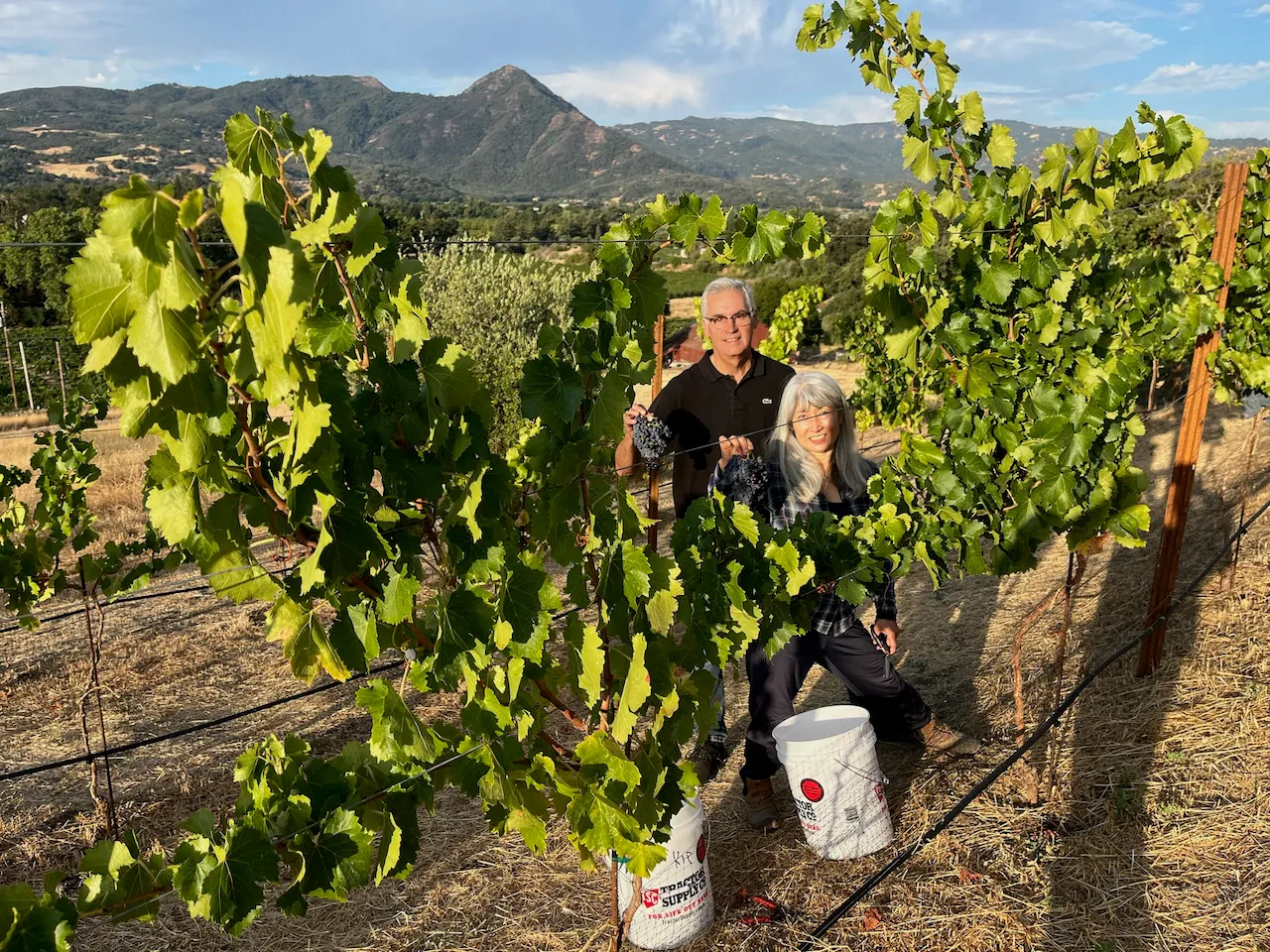
In late summer and early fall, the estate hosts two grape harvests of its two estate varietals — Cabernet Sauvignon and Grenache Noir — with de-stemming and crushing, the day closing out with a harvest dinner. Later, after the initial fermentation, comes pressing, a tasting of the freshly pressed juice, barreling, and a vertical tasting of previous vintages, followed in the evening by a harvest dinner paired with wines from nearby wineries. Every late fall there is also an olive harvest and a visit to a local mill where the olives are pressed into oil, the day culminating in a luncheon and olive-oil tasting. At this time, a visit to Arinesa Estate is by invitation to family and friends only.
The Beginning
Arinesa is the vision of a retired tech couple from Texas who realised their long-time goal of early retirement. Around 2016 they concluded that retirement was within an achievable five-year range, and began dreaming of life on a small vineyard. They had been enjoying California wine delivered to their Texas home — so why not get much closer to the source? They were not blind to the romantic notions of having a vineyard, but they also both enjoy being busy in a productive way: a retirement outdoors, in good weather, full of activity, though not necessarily of the roughing-it kind.
They learned of this property by sheer luck, during a January 2020 trip to view other parcels in the area — one of many such "land trips" since 2016 in search of their slice of heaven. They made an offer a couple of days later, still on the road. Then, owing to the COVID pandemic and seller delays, it took until December 2021 to finally close. Frustrating as that was, it was worth the wait.
The property was raw land: a septic system had to be installed, and water and electricity brought in. Construction of the residence took two years from first contact with the builder to final county inspection. Having built a custom home once before, they knew that being on site kept things moving and minimised undesirable decisions made on their behalf — so they put an Airstream on the property, travelling back and forth between Texas, California, and the Washington, D.C. area, where one of their adult children lives (another is in San Francisco). The adventure was well worth the outcome of their new home.
Before the Beginning
Around 1890 the town changed its name from Sanel to Hopland, after the hops that were then the major crop. In that era the Thatcher Hotel was built by pioneer William Thatcher — sparing no expense — as a grand outpost for travellers disembarking at a nearby train station, a major stop during the hops boom. By the mid-1900s the hop market had collapsed and Hopland's agriculture shifted to pears and, primarily, grapes, led by legacy families, many with roots in Italy. The hotel survived through decades of reinvention; after a long decline it found a new owner around 2019 and reopened, massively revitalised, as an upscale boutique hotel — a beautiful landmark once more, as it was in the late 1800s.
In 1910 almost the entire hill where Arinesa sits belonged to one of those legacy Italian families. Over time the family inherited and divided it, and some parcels were sold beyond the family. The stories say the land Arinesa sits on was once a vineyard turned grazing ground for horses and sheep, that the olive trees were planted before 1910, and that the historic barn at the bottom of the hill was once the first winery in Mendocino County — with a hidden underground store of forbidden elixir through Prohibition. We can't vouch for the accuracy, but that is what was told. Today a younger, hardworking couple lovingly restores that barn and the adjacent Mediterranean-style home, home now to three very cute goats and a flock of fluffy chickens.
In the early 2000s, an old survey shows, a developer planned to divide one side of the hill into a subdivision of a dozen homes. It never came to be. Around 2013 a Bay Area investor bought the property, held it for nearly a decade, then split it and sold a portion to the retired couple from Texas — who developed it into its current estate and named it Arinesa, a blend of their children's names. Being a tech couple, they also acquired the domain ArinesaEstate.com, in hopes of sharing updates with family and friends.